U.S. Dark Fiber Network Market Future Trends With Research 2030
U.S. Dark Fiber Network Market Growth & Trends
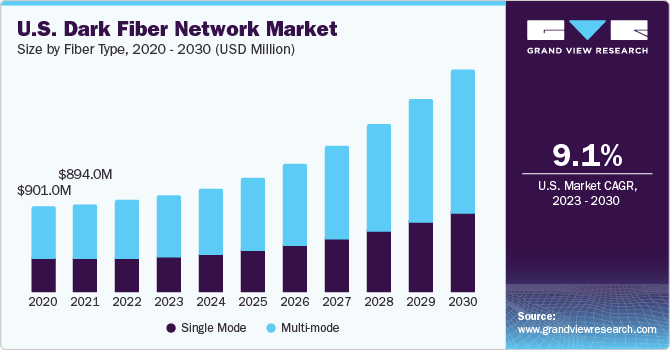
The U.S. dark fiber network market size is expected to reach USD 1.58 billion by 2030, according to a new report by Grand View Research, Inc. It is anticipated to progress at a CAGR of 6.8% from 2022 to 2030. Dark fiber has emerged as a sustainable solution for various organizations that are focusing on enhanced communication and network management. Continuously increasing penetration of internet services has paved the way for the high demand for internet bandwidth. This demand is expected to remain rampant over the forecast period. This is the most significant factor responsible for market growth across the region. The market is strongly supported by companies with a high reliance on internet connectivity.
U.S. Dark Fiber Network Market Segmentation
Grand View Research has segmented the U.S. dark fiber network market on the basis of fiber type, network type, and application:
Based on the Fiber Type Insights, the market is segmented into Single Mode and Multi-mode.
- In 2021, the multimode fiber type segment led the market and accounted for over 66.80% of the total market share. It is expected to continue leading the market over the forecast period. This type is best suited for short transmission distances. It is mainly used in video surveillance and Local-area Network (LAN) systems. Single-mode fiber, on the other hand, is best suited for longer transmission distances. It is mainly used in multi-channel television broadcast systems and long-distance telephony. The single-mode segment is anticipated to witness considerable growth over the projected period. This product type is used for long-distance installations ranging from 2 meters to 10,000 meters.
- It offers lower power loss in comparison to multimode. However, it is costlier than multimode fibers. Increasing penetration of internet services in the region has paved the way for an increased internet bandwidth requirement. Furthermore, growing cloud-based applications and rising demand for audio-video streaming & Video-on-Demand (VoD) services are further driving this requirement. Regulated demand for mobile data and the expected launch of 5G services are compelling telecom service providers to purchase the available dark fiber and focus on building their own fiber network. As such, the demand for dark fibers is expected to increase significantly in the coming years.
Based on the Network Type Insights, the market is segmented into Metro and Long-haul.
- The long-haul fiber network type segment remained the mainstay of the market in 2021 and accounted for the maximum share of more than 66.00% of the overall revenue. The segment continues to gather pace due to the capacity of these fibers to connect over large distances at low signal intensity. Such long-haul terrestrial networks are widely applied in undersea cabling across long oceanic distances. A long-haul network is driven by continuously growing investments, the development of smart cities, and strong competitive dynamics in the market. However, the broadening availability of metro network fibers at a relatively low cost is gradually swinging the momentum towards the segment.
- The report includes lease pricing analysis for the log-haul and metro routes. The pricing for dark fiber in the U.S. is based on the routes & locations and is sometimes plainly arbitrary. Also, it relies on several other parameters, such as market competition & demand and construction costs in a particular location. Generally, the U.S. dark fiber network pricing has been bifurcated into two major parts, including metro-area and long-haul area fiber. As developing fiber infrastructure requires a huge capital investment, many companies are inclined toward leasing dark fibers to reduce costs.
Based on the Application Insights, the market is segmented into Telecom, Oil & Gas, Military & Aerospace, BFSI, Medical, Railway, Others.
- In terms of revenue, the telecommunication segment dominated the market with a share of more than 41.00% in 2021 and is anticipated to retain its dominance during the forecast period. Telecommunication is anticipated to present promising growth prospects due to the growing adoption of the 5G technology in communication and data transmission services. Dark fiber enables high-speed data transfer services in both small- and long-range communications. Furthermore, increasing cloud-based applications, audio-video services, and Video-on-Demand (VoD) services stimulate demand. The growing civil engineering sector is a crucial driver of the market.
- A rise in commercial and industrial construction activities is expected to increase the demand for fiber connectivity and hence drive the market. The growing expenditure on the defense and military sector in the U.S. has increased dark fiber usage across various applications, such as surveillance border security. The overall penetration of LTE (4G) and the growing adoption of 5G have fueled the demand for bandwidth for backhaul at U.S. cell sites in the last few years. The intense price war among mobile operators and ever-increasing consumer bandwidth consumption have forced mobile operators to opt for dark fiber networks.
Key Companies Profile & Market Share Insights
The market participants adopt various strategies, such as mergers & acquisitions, product developments, collaborations, partnerships, and expansions, to cater to customer demands.
Some of the prominent players operating in the U.S. dark fiber network market include,
- AT&T Intellectual Property
- Comcast
- Consolidated Communications
- Verizon Communications, Inc.
- Lumen Technologies, Inc.
- Crown Castle International Corp.
- Zayo Group, LLC.
Order a free sample PDF of the U.S. Dark Fiber Network Market Intelligence Study, published by Grand View Research.


Comments
Post a Comment