Non-alcoholic Steatohepatitis Clinical Trials Market Size, Estimates, And Forecast To 2030
Non-alcoholic Steatohepatitis Clinical Trials Market Growth & Trends
The global non-alcoholic steatohepatitis clinical trials market size is expected to reach USD 4.2 billion by 2030, registering a CAGR of 6.5% over the forecast period, according to a new report by Grand View Research, Inc. Rising healthcare expenditure, cases of obesity, and prevalence of non-alcoholic steatohepatitis (NASH) are the factors driving the growth of this market. Due to the COVID-19 pandemic, enrollment in new drug clinical trials for NASH patients was halted, but people shifted to alternate means of data collecting methods, like virtual visits. Non-alcoholic Steatohepatitis is a fatty liver disease that causes scarring and damage to the liver.
Non-alcoholic Steatohepatitis Clinical Trials Market Segmentation
Grand View Research has segmented the global non-alcoholic steatohepatitis clinical trials market based on phase, study design, and region:
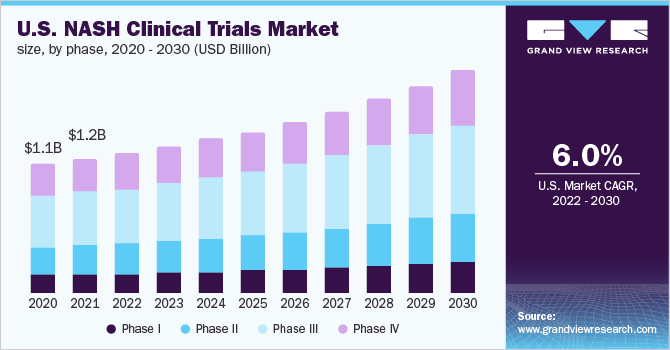
Based on the Phase Insights, the market is segmented into Phase I, Phase II, Phase III, Phase IV.
- The segment of phase III accounted for more than 39.5% of the global revenue share in 2021. The phase III trials are associated with high costs. For instance, a single phase 3 study costs around USD 100 million. Hence, the failure of such trials causes a major financial impact on the sponsors. A Phase III trial gathers further data on the drug’s safety and effectiveness by evaluating different populations and dosages, as well as using it in conjunction with other drugs. The most successful and cost-effective way to identify and monitor NASH patients for clinical trials is to use smart, quantitative imaging in combination with other clinical markers for NASH. According to current FDA guidelines, all Phase 3 NASH trials must involve at least two liver biopsies.
- One at the start of the study to verify the patient’s eligibility, and another at the end to assess treatment efficacy. The complete cost of a liver biopsy, including the procedure, processing, and pathologist read, is expected to be USD 7,000 or more. In addition to the economic costs of a liver biopsy, the method’s low precision and subjective nature are inherent in the operation. Despite the well-known limitations of liver biopsy, the need that it be included in a NASH study could lead sponsors to be hesitant to add more quantitative measurements in a clinical trial. However, even in Phase 2 and Phase 3 studies that entail liver biopsy, careful use of LiverMultiScan as a screening tool can minimize enrollment costs by avoiding costly, unneeded biopsies.
Based on the Study Design Insights, the market is segmented into Interventional, Observational, Expanded Access.
- The interventional segment dominated the market with the largest share of more than 45.5% in 2021. In December 2019, there were 84 ongoing interventional studies with patients enrolled to evaluate the therapeutic efficacy of therapies for NASH. The majority of these trials are investigating novel drugs as monotherapies, with some exploring into combination therapy for NASH. The FDA and the EMA recognized that the reliable way to diagnose NASH is through a histopathological analysis of a tissue sample obtained from a liver biopsy. Biomarkersare a point of contention between the EMA and the FDA.
- In phase 2 of a trial, the FDA strongly recommends the use of a biomarker signature method. The EMA does not forbid such a strategy from being used in phase 2, but it also does not necessitate it to be used in phase 2. As a result, interventional trialists are in high demand. Expanded access trials, also known as compassionate use trials, are expected to grow at the fastest CAGR of 6.9% during the forecast period. As no satisfactory therapies are available, it could be a viable option for patients with significant disease conditions to receive treatment outside of a clinical trial. The expanded access trials market is expected to be driven by increasing innovation in NASH clinical trial approaches.
Non-alcoholic Steatohepatitis Clinical Trials Regional Outlook
- North America
- Europe
- Asia Pacific
- Latin America
- Middle East & Africa
Market Share Insights
- November 2021: GlaxoSmithKline announced it is making its first massive effort into treating the fatty liver disease known as nonalcoholic steatohepatitis (NASH) with a USD 1 billion asset deal with Arrowhead Pharmaceuticals.
- March 2021: Gilead Sciences, Inc. and Novo Nordisk announced that their trial partnership in non-alcoholic steatohepatitis has been expanded.
- January 2021: Terns Pharmaceuticals introduced two NASH candidates in clinical trials. The company received USD 87 million in investment from Eli Lilly and Deerfield Management after leasing three NASH candidates.
Key Companies Profile & Market Share Insights
Market players are undertaking various strategic initiatives, such as the signing of the new partnership agreement, collaborations, mergers & acquisitions, geographic expansion, aiming to strengthen their services, & manufacturing capacities, thus providing a competitive advantage.
Some of the prominent players operating in the global non-alcoholic steatohepatitis clinical trials market include,
- Pfizer Inc.
- Novartis AG
- Icon Plc
- LabCorp
- Allergan Plc
- Cadila Healthcare Ltd.
- Shire Plc (Takeda Pharmaceuticals)
- Eli Lilly
- Novo Nordisk
- Gilead Sciences Inc.
- Glaxosmith Kline
- Arrowhead Pharmaceuticals
Order a free sample PDF of the Non-alcoholic Steatohepatitis Clinical Trials Market Intelligence Study, published by Grand View Research.


Comments
Post a Comment