Anti-acne Dermal Patch Market Competition by Manufacturers 2030
Anti-acne Dermal Patch Market Growth & Trends
The global anti-acne dermal patch market size is expected to reach USD 870.3 million by 2030, according to a new report by Grand View Research, Inc. The market is expected to expand at a CAGR of 6.1% from 2022 to 2030. The growing prevalence of acne vulgaris is boosting the adoption of instant treatments pertaining to the conditions such as acne patches, thus propelling market growth. There has been a surge in the number of anti-acne dermal patch brands being commercialized across the globe. Hence, increasing product launches in this industry have significantly boosted its revenue growth. Moreover, the rising number of companies expanding their geographic presence across the developing as well as developed economies have further supported the market’s positive growth trajectory across the forecast period.
Anti-acne Dermal Patch Market Segmentation
Grand View Research has segmented the global anti-acne dermal patch market based on type, age group, distribution channel, and region:
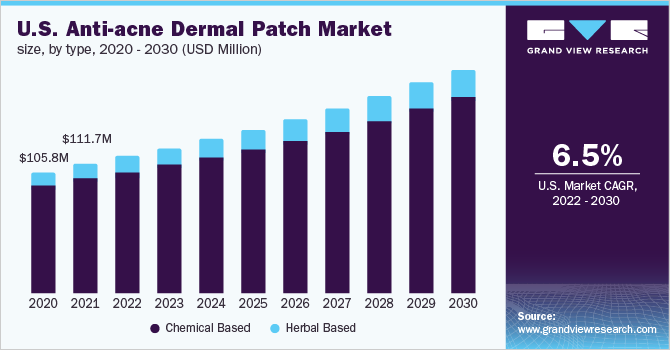
Based on the Type Insights, the market is segmented into Chemical based and Herbal based.
- The herbal-based anti-acne dermal patch segment is anticipated to witness the highest growth rate of 7.4% across the forecast period as compared to chemical-based patches. Generally, acne patches in the market are composed of synthetic substances. Natural acne patch does not have any synthetic substances in their compositions and is made from ingredients such as Silk and mulberries that can be easily produced. Silk consists of fibroin and sericin. Fibroin can enhance the growth rate of fibroblast which can quickly treat acne wounds. Increasing demand for herbal-based skincare products across the globe due to their natural healing properties without any side effects is one of the major factors supporting the growth of the herbal-based anti-acne dermal patch segment.
- The chemical-based anti-acne dermal patch segment on the other hand is poised to hold a significant share in the market for anti-acne dermal patch across the forecast period. This is because the majority of the anti-acne dermal patch across the industry are chemical-based due to their instant healing properties compared to herbal patches. Moreover, an increasing number of product launches in the category will strongly support the highest shares of the segment.
Based on the Age Group Insights, the market is segmented into 10 to 17, 18 to 44, 45 to 64, 65+.
- The 18 to 44 age group segment held a maximum revenue share of 55.2% of the market for anti-acne dermal patch in 2021. Based on age group, the market has been segmented into age groups of 10 to 17, 18 to 44, 45 to 64, 65+. The 18 to 44 age group segment is expected to maintain its dominance during the forecast period. This is because the highest incidence of acne is prevalent among this age group. For instance, as per an article published by Botanix Pharmaceuticals Ltd, 54% of acne patients are diagnosed between the age group of 18 to 44 years.
- The 10 to 17 age group segment is poised to witness considerable growth in the market for anti-acne dermal patch across the forecast period owing to an increasing number of teenagers adopting acne patches across the globe. High adoption is due to the strong social media marketing of the products that attract a large portion of the teenage population.
Based on the Distribution Channel Insights, the market is segmented into Retail Stores, Pharmacies & Drug Stores, E-Commerce Platform.
- The pharmacies and drug stores segment dominated the market and held the highest revenue share of 45.5% in 2021. The segment is expected to account for the largest revenue share during the forecast period. The high growth of the segment is majorly attributable to the increasing use of OTC products from drug stores and pharmacies for the self-management of acne. For instance, a survey conducted among the pharmacies across Germany, by the University Clinic for Dermatology and Venereology, stated that more than 35% of patients prefer self-treatment of mild acne using OTC products. Hence, the aforementioned reason is one of the strongest factors supporting the growth of the segment.
- The e-commerce platform segment on the other hand is poised to witness lucrative growth in the market for anti-acne dermal patch across the forecast period. The high growth of the segment is majorly attributable to the outbreak of the COVID-19 pandemic that has led to a surge in significant demand for e-commerce platforms delivering such products. Most of the manufacturers are going digital and adopting aggressive marketing techniques to boost sales. The manufacturing companies are also using existing online shopping platforms and social media to expand the reach of their products to potential consumers.
Anti-acne Dermal Patch Regional Outlook
- North America
- Europe
- Asia Pacific
- Latin America
- Middle East & Africa
Key Companies Profile & Market Share Insights
This market for anti-acne dermal patch is fragmented in nature due to the presence of a substantial number of developed as well as medium to small-sized acne patch companies. Several market participants are privately held or are a part of private equity firms’ portfolios.
Some of the prominent players operating in the global anti-acne dermal patch market include,
- Peter Thomas Roth Labs LLC
- Rael
- ZitSticka
- 3M
- Starface
- DermaAngel
- Hero Cosmetics
- Sephora USA, Inc.
- Urban Outfitters
- Peach & Lily
- COSRX
- Alba Botanica
- Peace Out Skincare
Order a free sample PDF of the Anti-acne Dermal Patch Market Intelligence Study, published by Grand View Research.


Comments
Post a Comment