Micro-Magnetic Resonance Imaging Market Key Players and Growth Information Analysis Report 2030
Micro-Magnetic Resonance Imaging Market Growth & Trends
The global micro-magnetic resonance imaging market size is expected to reach USD 2.5 billion by 2030, registering a CAGR of 4.3%, according to a new report by Grand View Research, Inc. Growing technological advancements in the field of micro-magnetic resonance imaging, increase in adoption of non-invasive small-animal imaging techniques, and increased funding to support preclinical research is expected to boost the market growth for micro-magnetic resonance imaging (MRI). Micro MRI is an efficient system since it does not use ionizing radiation, provides good spatial resolution, and is particularly suitable for imaging soft tissues. Micro-MRI has a wide range of applications in small animals, including functional, anatomical, and molecular imaging. And is used in a variety of fields, including pharmacology, brain mapping, neurodegenerative illness, and psychiatry.
Micro-Magnetic Resonance Imaging Market Segmentation
Grand View Research has segmented the global micro-magnetic resonance imaging market based on type, end-use, and region:
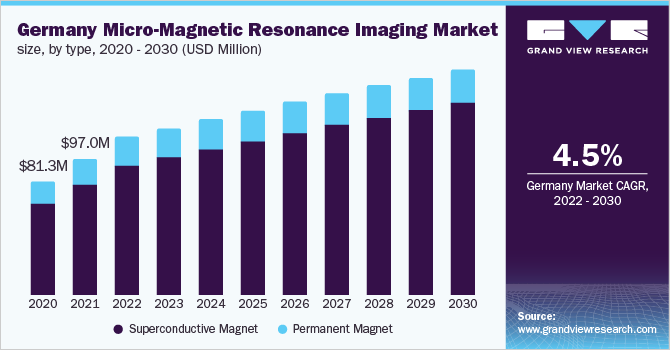
Based on the Type Insights, the market is segmented into Superconductive Magnet and Permanent Magnet.
- The superconducting magnets segment dominated the market for micro-magnetic resonance imaging and accounted for the largest revenue share of 81.4% in 2021. This growth is due to their property of conducting a magnetic field without any electric resistance, enabling the magnet to produce much larger electric currents. Advantages of superconducting magnets such as high signal-to-noise ratio, enhanced resolution, and improved image quality, have influenced the performance of MRI systems used in clinical practice and preclinical research. These magnets are more reliable in case of quench, as it closely monitors helium levels and reports the abnormalities.
- Additionally, the magnet is associated with an emergency system that enables heaters to be fired to initiate quench and quickly discharge the magnet if ever necessary. Thus, superconducting magnets are likely to mask the permanent magnets in the near future. However, the low price range and reduced need for electric power or coolant associated with the permanent magnets, have found their way into low field strength MRI. The conductor used in most MRI systems is niobium-titanium (NbTi) which is superconductive below 9.4K. Magnesium diboride (MgB2), is another emerging superconductive material for micro-MRI.
Based on the End-use Insights, the market is segmented into Universities and Academic, Biotechnology and Pharmaceutical Companies, Preclinical Imaging and Testing Facilities, Contract Research Organizations, Others.
- The preclinical imaging and testing facilities segment is expected to witness the highest CAGR of 5.0% in the forecast period. Increased research to develop advanced cancer therapies, brain aneurysm screening, and developing new drug molecules to treat critical diseases are factors that are likely to drive the segment growth in coming years. These centers have the capacity to invest in costly MRI equipment, thereby propelling the market growth. On the other hand, the universities and academics segment is said to acquire the largest share in the market, due to increased research funding from the government and market leaders and ongoing research on the reconstruction of peripheral nerve fascicles undertaken at university levels.
- Research organizations and private biomedical science institutes are a part of the others segment in this market for micro-magnetic resonance imaging. Such organizations are actively collaborating with market leaders to develop high tesla preclinical MRI systems. For instance, Bruker and Champalimaud Foundation (Portugal) collaborated to develop the first-ever 18 T MRI for preclinical studies on advancing translational cancer and neuroscience research. The Champalimaud Foundation is involved in research on oncology and neuroscience. This 18T advanced system is likely to support the foundation’s in vivo research into cancer, brain plasticity, and neurodegenerative disease models.
Micro-Magnetic Resonance Imaging Regional Outlook
- North America
- Europe
- Asia Pacific
- Latin America
- Middle East & Africa
Key Companies Profile & Market Share Insights
The market for micro-magnetic resonance imaging includes the presence of large and small players. These players are constantly collaborating with Academic centers and Universities and other end-use areas to influence the preclinical studies in the market.
Some of the prominent players operating in the global micro-magnetic resonance imaging market include,
- Bruker
- Siemens Healthineer
- Phillips
- Varian
- Mediso
- MR Solutions
- Aspect Imaging
- Agilent
- Cubresa
- United Imaging
- Time Medical System
Order a free sample PDF of the Micro-Magnetic Resonance Imaging Market Intelligence Study, published by Grand View Research.


Comments
Post a Comment