Real Estate Software Market Incremental Opportunity Assessment till 2028
Real Estate Software Industry Overview
The global real estate software market size is expected to reach USD 18.66 billion by 2028, expanding at a CAGR of 9.7% from 2021 to 2028, according to a new study by Grand View Research, Inc. Factors such as a rise in commercial and residential real estate activities, rising urbanization, and the adoption of new software tools for reducing manual errors are driving the market. Technological advancements, the rising implementation of cloud and Artificial Intelligence (AI), and the rising demand for better business workflows are favoring the market growth. Moreover, the increase in smart city development projects is driving the demand for real estate software.
Real Estate Software Market Segmentation
Grand View Research has segmented the global real estate software market based on type, deployment, end-use, application, and region:
Based on the Type Insights, the market is segmented into Customer Relationship Management Software, Enterprise Resource Planning Software, Property Management Software, Contract Software, Others.
- The Customer Relationship Management (CRM) software segment dominated the market in 2020 and accounted for nearly 25% of the revenue share. CRM software supports realtors in staying organized, moving tenants, following up with potential buyers, and closing sales deals on properties. CRM software also helps improve productivity and efficiency by speeding up routine processes and keeping customers and clients up to date about recent updates. The adoption of smart technologies and enterprise applications for project management could further drive the segment growth. Additionally, the rising demand for CRM solutions for ensuring the security of sensitive information could have a positive impact on the CRM software segment.
- The contract software segment is expected to grow significantly from 2021 to 2028, registering a CAGR of more than 11%. Contract management software can assist in tightening inspection, compliance with regulatory requirements, reducing investor fears, and building customer trust. Data privacy regulation compliance facilitates protection from internal and external security threats, thus building trust among real estate customers. The adoption of digital technologies such as e-signatures and AI-assisted contract management are driving the growth of this segment.
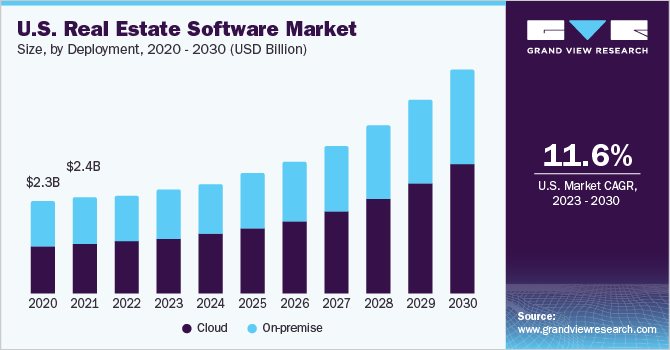
Based on the Deployment Insights, the market is segmented into Cloud and On-premise.
- The cloud segment dominated the market in 2020 and is expected to expand at more than 11% CAGR from 2021 to 2028. Cloud-based software provides faster and efficient data access to real estate companies, thus increasing their workflow productivity. Moreover, efficient management of large volumes of data is possible through the cloud deployment model that has higher security standards. The significant growth in construction activities globally is expected to drive the usage of cloud technologies to better manage businesses and help improve efficiency and productivity by using data to streamline processes.
- As compared to the on-premise deployment model, the cloud model does not require additional hardware, making it cost-efficient and economical for small-scale businesses. Furthermore, the storage capacity of the cloud can be easily upgraded or downsized based on requirements and the pay-as-you-go feature makes it more attractive. Moreover, cloud-based construction and project management solutions offer organizations functionalities such as project management, scheduling, and automating tasks into a single dashboard, which could deflate the demand for on-premise solutions.
Based on the End-use Insights, the market is segmented into Architects & Engineers, Project Managers, Real Estate Agents, Others.
- Real estate software is majorly used by architects and engineers, owing to which the architects and engineers segment captured nearly 40% of the overall revenue share in 2020. The segment is expected to continue to dominate the market during the forecast period as well. The rising demand for commercial and residential real estate is compelling architects and engineers to spend increasing time developing feasibility reports for new projects. Real estate software ensures the easy and quick generation of these reports, allowing engineers and architects to focus on their core tasks. Additionally, real estate software helps provide interactive, virtual tours of property that can be used by architects to provide customers a better understanding of their designs.
- The real estate agents segment is expected to emerge as the fastest-growing segment over the forecast period. This can be attributed to the increase in the adoption of digital technologies such as Virtual Reality (VR), AI, and blockchain in the real estate industry. Real estate agents have started adopting digital technologies such as remote property viewing, remote marketing and sales, and digital management of properties to attract and retain customers. For instance, the Zoho CRM software built for real estate agents offers property management, sales process management, and automation features for real estate agents and real estate developers.
Based on the Application Insights, the market is segmented into Commercial and Residential.
- The residential application segment captured the largest share of nearly 55% in 2020. However, the commercial application is projected to emerge as the fastest-growing segment over the forecast period. Real estate software demand in the residential and commercial sectors has seen significant growth in recent years. The rising preference for homeownership and constantly rising residential property prices are also driving the demand for real estate software. Buildings have seen an increase in modern infrastructure and commercial spaces have grown significantly in previous years.
- Real estate software helps residential and commercial property builders to track associated tasks such as transaction updates, storage of legal documents, property management, and easy handling of property accounts. Many countries have also seen an increase in the number of retail shops that require knowledge about property and building leases. Real estate software solutions can assist businesses and customers to acquire relevant knowledge.
Real Estate Software Regional Outlook
- North America
- Europe
- Asia Pacific
- Latin America
- Middle East & Africa
Key Companies Profile & Market Share Insights
Companies are focusing on mergers & acquisitions and new product launches. Increased demand for automation by property developers to generate leads through their websites and other relevant content is resulting in the growth of the market.
Some of the prominent players operating in the global real estate software market include,
- Altus Group Ltd.
- Autodesk Inc.
- CoStar Realty Information Inc.
- Microsoft Corporation
- MRI Software LLC
- Oracle Corporation
- RealPage Inc.
- SAP SE
- Trimble Inc.
- Yardi Systems Inc.
Order a free sample PDF of the Real Estate Software Market Intelligence Study, published by Grand View Research.


Comments
Post a Comment