Inhaled Nitric Oxide Delivery Systems Market Manufacturing Cost Analysis Report 2028
Inhaled Nitric Oxide Delivery Systems Industry Overview
The global inhaled nitric oxide delivery systems market size is estimated to reach USD 434.2 million by 2028 registering a CAGR of 6.9%, according to a new report by Grand View Research, Inc. A rise in the cases of respiratory failure among neonates, increased pollution levels leading to lung diseases in adults, need for quick treatment response, and reduced complications are the factors driving the adoption of inhaled nitric oxide therapy. The presence of several small-scale manufacturers and research initiatives undertaken by major players to prove treatment efficacy against the SARS-CoV-2 virus further enhances market growth.
Inhaled Nitric Oxide Delivery Systems Market Segmentation
Grand View Research has segmented the global inhaled nitric oxide delivery systems market on the basis of type, product, application, end user, and region:
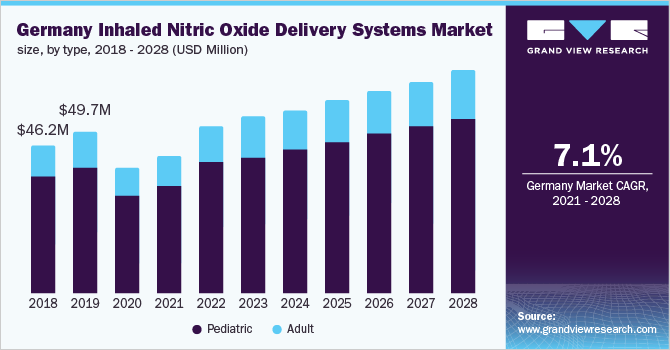
Based on the Type Insights, the market is segmented into Pediatrics and Adult.
- The pediatric segment accounted for the largest revenue share of 77.6% in 2020. Inhaled nitric oxide is proved to be the most effective in treating neonatal diseases like Hypoxic Respiratory Failure (HRF). In the U.S. alone, nearly 25,000 to 30,000 neonatal HRF cases are reported annually and nearly 50% are cured using INO therapy.
- Hence, to fulfill the large medical expense, the government in most countries has established favorable reimbursement policies, which improves the adoption of INO therapy in the neonatal segment. Inhaled nitric oxide needs to be administered in large concentrations in most adult infected diseases and a lack of clinical evidence has led to the reduced adoption of this therapy in the adult segment.
Based on the Application Insights, the market is segmented into Hypoxic Respiratory Failure (HRF), Acute Hypoxemic Respiratory Failure (AHRF) and Others.
- Hypoxic Respiratory Failure (HRF) inhaled nitric oxide delivery system held the largest segment share of 80.2% in 2020. This disease is mainly observed in pre-term and near-term neonates due to underlining diseased conditions like pneumonia, sepsis, persistent pulmonary hypertension, and others. It affects 2% of all live births and is responsible for >33% of all neonatal mortality.
- Acute Hypoxemic Respiratory Failure (AHRF) is another critical illness needing INO therapy as a treatment regime. The mortality rate associated with this condition is nearly 30% but moves up to 50% as it develops complications of sepsis leading to multi-organ failure. Thus, local acting vasodilators like INO have proven to be an effective first-line treatment. Chronic Obstructive Pulmonary Disorder (COPD) and Bronchopulmonary Dysplasia (BPD) are among a few other application areas of INO therapy.
Based on the Product Insights, the market is segmented into Disposables and System.
- The disposables product segment accounted for the largest revenue share of 65.1% in 2020. On the basis of product, the market is bifurcated into systems and disposables. The presence of a number of manufacturers and increased demand for nebulizer masks in hospitals have led to the increased demand for disposables, thereby driving the segment growth.
- Factors, such as the low cost of raw materials, abundant resource availability, and a large consumer base, are also anticipated to boost segment growth. INO delivery devices are priced at USD 1400-1700, which makes it difficult for low-tier end-user settings to adopt such equipment as they focus on minimizing the bills. Thus, only large-scale hospitals with the availability of skilled staff and numerous ICU beds can acquire INO systems, which, in turn, leads to a lower share of the system segment.
Based on the End-user Insights, the market is segmented into Hospitals, Ambulatory Centers and Clinics.
- The hospitals segment captured the highest revenue share of 86.2% in 2020 owing to the ease of delivery, ability to liquidate for establishing INO delivery device and monitor system, a large number of staff to track device operations, and presence of emergency department. On the basis of end user, the market is segmented into hospitals, surgical centers, and clinics.
- Mortality rates due to ARFare around 30% in the world. Hence, it is essential to provide these patients with life support and critical care, such as that in hospital ICUs. A rise in the number of hospital admissions is leading to the growth of this segment. On the other hand, ambulatory centers and clinics lack the necessary infrastructure and medical budget, which leads to reduced patient admissions and a lower market share of these segments.
Inhaled Nitric Oxide Delivery Systems Regional Outlook
- North America
- Europe
- Asia Pacific
- Latin America
- Middle East & Africa
Key Companies Profile & Market Share Insights
The market is highly exploited due to the presence of local manufacturers and sellers in most regions. Large-scale manufacturers are undergoing research to prove the treatment efficacy of INO against COVID-19-infected patients. Once they establish positive clinical trial results, the quicker they receive FDA approval to market their product.
Some of the prominent players operating in the global inhaled nitric oxide delivery systems market include,
- Mallinckrodt Pharmaceuticals
- Getinge
- Vero Biotech
- LINDE
- Beyond Air
- SLE
- NU MED
- Bellerophon Therapeutics
- Air Liquide Healthcare
- Circassia Pharmaceuticals
Order a free sample PDF of the Inhaled Nitric Oxide Delivery Systems Market Intelligence Study, published by Grand View Research.


Comments
Post a Comment