Digital Product Passport Market: The Technology Turning Products Into Digital Identities
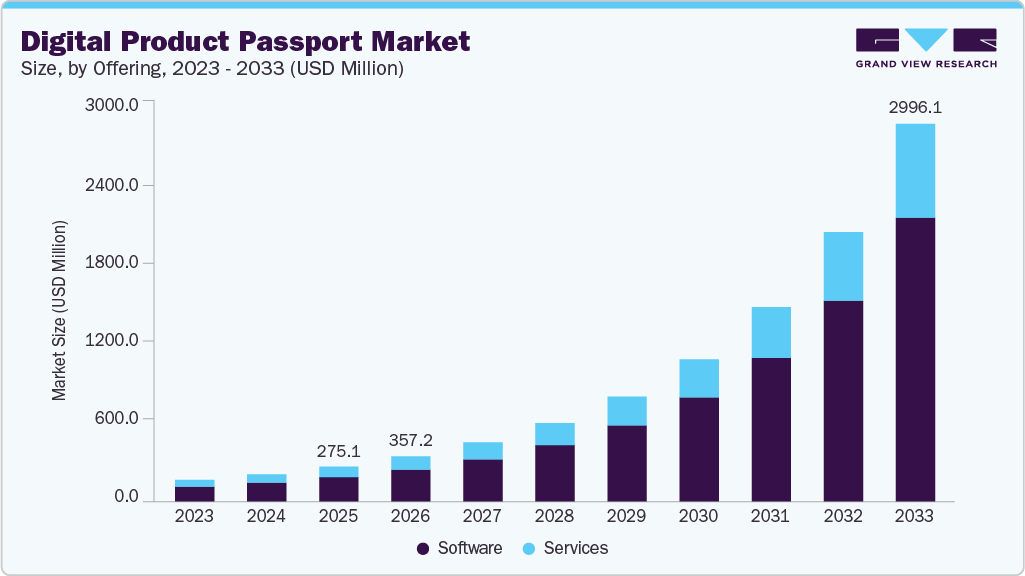
The global Digital Product Passport (DPP) market is expanding at one of the fastest rates in the compliance-technology space. It's valued at USD 275.1 million in 2025, estimated to reach USD 357.2 million in 2026, and projected to climb to USD 2,996.1 million by 2033, a compound annual growth rate of 35.5% between 2026 and 2033. What makes this market unusual isn't just the growth rate — it's that the demand curve is being written almost entirely by regulators before the technology has even matured, a sequencing that rarely happens this cleanly in enterprise software.
What Is Actually Driving the Digital Product Passport Market?
Most explanations of DPP growth stop at "sustainability demand," which understates what's happening. Three distinct forces are compounding at once.
The first is regulatory mandate, not preference. The EU's Ecodesign for Sustainable Products Regulation (ESPR) and the Circular Economy Action Plan are turning DPPs from an optional transparency initiative into a market-access requirement — by 2030, products sold in the EU are expected to carry a passport by default (well before the market's 2033 forecast horizon closes), meaning companies without one may simply be unable to sell into the bloc. That's a fundamentally different adoption trigger than typical software demand, which usually starts with efficiency gains and only later attracts compliance framing.
The second is the shift from static labeling to active infrastructure. Early DPP pilots amounted to a QR code linking to a spec sheet. The current generation increasingly combines blockchain for tamper-proof provenance records, IoT sensors for real-time condition monitoring, and AI systems that process lifecycle data to forecast component behavior and automate compliance reporting. This matters because it changes the buying committee: a passport that only stores data is a marketing or compliance purchase, while a passport that feeds predictive maintenance or resale logic becomes an operations purchase — which pulls in far larger budgets.
The third, and least discussed, driver is the emergence of DPPs as a commercial channel rather than a cost center. Fashion brands are already using passport data to power authenticated resale, repair booking, and recycling take-back programs directly from the product's digital record. That reframes the passport from a regulatory line item into a customer-retention and secondary-revenue tool, which is why services around DPP strategy — not just the software licenses — currently capture the largest share of market revenue, at just over 30% in 2024. Software is growing faster on a percentage basis as standards stabilize, but services remain the entry point because most enterprises are still translating regulatory text into a working data architecture, not buying off-the-shelf tools.
Download a free sample report or claim your copy of this full market intelligence report
Where Is Adoption Concentrated Right Now?
Europe holds 36.29% of global market share in 2024, which is unsurprising given it's also the source of the binding regulation. What's more telling is which sectors inside Europe are moving first. Textile and apparel leads industry adoption, a direct consequence of the EU prioritizing fashion in its sustainable product policy, combined with a structural fit: apparel's high SKU counts and short product lifecycles make digital tracking a genuine operational upgrade, not just a compliance checkbox. Germany's National Circular Economy Strategy, finalized in December 2024 with a 2045 climate-neutrality target, has pulled industrial names like Siemens and Bosch into early DPP deployment, while UK brands such as Nobody's Child are running pilot programs ahead of a planned late-2025 rollout — a hedge against EU market-access rules even outside the bloc.
North America is closer behind than most coverage suggests, holding roughly 35% of global share in 2024. That's a narrow gap against Europe's lead, and it reflects something worth noting: US adoption isn't waiting for domestic regulation to catch up. It's being pulled forward by companies that sell into the EU and need passport-ready supply chains regardless of what US law eventually requires — effectively importing European compliance standards as a de facto global baseline.
Asia-Pacific tells a bifurcated story. China is moving quickly on the manufacturing side, using blockchain-based traceability to align with both domestic modernization goals and export-market compliance, positioning DPP adoption as much as a trade-credibility signal as a sustainability one. India, by contrast, is still in early awareness stages within textile and apparel exports, constrained by fragmented standards and limited in-house technical capacity — a gap that pilot programs and exporter education are only beginning to close.
The Overlooked Constraint: Interoperability, Not Technology
Coverage of this market tends to frame the growth story purely as demand outpacing supply. A more accurate read is that demand is outpacing standardization. On-premises deployment still holds a significant share of the market, largely because heavily regulated sectors — automotive, aerospace, industrial manufacturing — prioritize data sovereignty over convenience, and because early movers built proprietary systems before common data formats existed. Cloud deployment is growing fastest, but the real bottleneck for the entire market isn't cloud versus on-premises. It's the absence of a settled cross-border data schema.
This is precisely the gap that coordination initiatives like CIRPASS, an EU-funded project convening industry, researchers, and regulators, are trying to close by defining shared technical specifications for electronics, batteries, and textiles. Until those specifications lock in, enterprises are effectively building on shifting ground: a passport architecture that satisfies today's guidance could require costly rework once EU-wide standards formalize. That uncertainty, more than budget or technical capability, is what currently separates DPP leaders — companies like Avery Dennison offering full Digital Product Passport as a Service bundles, or Siemens' battery passport platform — from the broader market still running pilots.
What This Means Going Forward
The consumer electronics segment is worth watching closely as the next adoption wave, driven by scrutiny over e-waste, critical raw materials, and extended producer responsibility rules — pressures structurally similar to what pushed textiles into early adoption. Buyers evaluating DPP vendors right now would do well to weight interoperability and standards alignment as heavily as feature sets, since a passport that can't exchange data across a fragmented, multi-jurisdiction supply chain will need replacing well before the 2033 forecast horizon closes.
Looking for more in-depth data focusing on specific segments or regions? Get this report customized with inclusion of custom data sets to suit your exact business needs


Comments
Post a Comment