Additive Manufacturing Market Regional Opportunities And Future Scope Report 2030
Additive Manufacturing Market Growth & Trends
The global additive manufacturing market size is estimated to reach USD 76.16 billion by 2030, growing at a CAGR of 20.8% over the forecast period, according to a new report by Grand View Research, Inc. The growth of the market can be attributed to the growing adoption of Additive Manufacturing (AM) in industrial applications for enhancing production and shortening the time to market. The growing adoption of three-dimensional printers by the incumbents of automotive, healthcare, and aerospace & defense, among other industries and industry verticals, is also expected to drive the growth of the market over the forecast period.
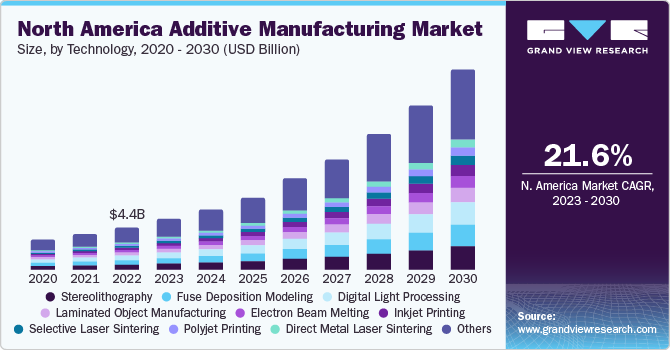
Additive Manufacturing Market Segmentation
Grand View Research has segmented the global additive manufacturing market based on component, printer type, technology, software, application, vertical, material, and region:
Based on the Component Insights, the market is segmented into Hardware, Software, Services.
- The hardware segment dominated the market in 2021 and accounted for a revenue share of more than 60%. The strong emphasis manufacturing entities continued to put on pursuing advanced manufacturing practices and rapid prototyping allowed the hardware segment to dominate the market. The hardware segment is poised for significant growth over the forecast period owing to various factors, such as rapid industrialization, the growing demand for consumer electronics products, the continued development of civil infrastructure, rapid urbanization, and optimized labor costs.
- Technology proliferation, the growing adoption of rapid manufacturing processes, such as rapid prototyping, and the widening application portfolio of additive manufacturing across various industries and industry verticals are expected to propel the demand for all the components associated with additive manufacturing. The technology allows layer-by-layer procedural manufacturing of three-dimensional objects that are connected through a system comprising applicable digital files.
Based on the Printer Type Insights, the market is segmented into Desktop 3D Printer and Industrial 3D Printer.
- The industrial 3D printer segment dominated the market in 2021 and accounted for a revenue share of more than 63%. Industrial 3D printers are being adopted extensively across various industries and industry verticals, including automotive, electronics, aerospace & defense, and healthcare, among others, for some of the common applications, such as prototyping, designing, and tooling. Given the extensive adoption of additive manufacturing for prototyping, designing, and tooling, the industrial 3D printer segment is expected to continue dominating the market over the forecast period.
- Desktop 3D printers were initially limited to hobbyists and small enterprises. However, desktop 3D printers are increasingly being used for household and domestic purposes. Schools, educational institutes, and universities are also adopting desktop 3D printers for technical training and research purposes. Smaller businesses are typically adopting desktop 3D printers and diversifying their business operations to offer additive manufacturing and other related services. Hence, the demand for desktop printers is expected to rise significantly over the forecast period.
Based on the Technology Insights, the market is segmented into Stereolithography, Fuse Deposition Modelling, Selective Laser Sintering, Direct Metal Laser Sintering, Polyjet Printing, Inkjet Printing, Electron Beam Melting, Laser Metal Deposition, Digital Light Processing, Laminated Object Manufacturing, Others.
- The stereolithography segment dominated the market in 2021 and accounted for a revenue share of more than 8%. Stereolithography happens to be one of the oldest and most conventional printing technologies. Apart from ease of operations, there are several other advantages associated with stereolithography, which are encouraging the adoption of the technology. However, advances in technology and aggressive research & development activities being pursued by industry experts and researchers are opening opportunities for several other efficient and reliable technologies
- Apart from stereolithography, there are several other additive manufacturing technologies used in the market. They include fuse deposition modeling (FDM), direct metal laser sintering (DMLS), selective laser sintering (SLS), inkjet printing, polyjet printing, laser metal deposition, and electron beam melting (EBM), digital light processing (DLP), laminated object manufacturing, and others. While FDM is also adopted significantly; DLP, EBM, inkjet printing, and DMLS are also gaining significant traction as these technologies are applicable in specialized additive manufacturing processes.
Based on the Software Insights, the market is segmented into Design Software, Inspection Software, Printer Software, Scanning Software.
- The design software segment dominated the market in 2021 and accounted for a revenue share of more than 30%. The segment is also expected to continue dominating the market over the forecast period. Design software is used for constructing the designs of the object to be printed, particularly in the automotive, aerospace & defense, and construction & engineering industries. There are several advantages associated with design software. One of the advantages is the capability of design software to serve as a bridge between the object to be printed and the printer’s hardware.
- Apart from design software, there are other different types of software used in the market. They include scanning software, printer software, and inspection software. The demand for scanning software is poised for significant growth over the forecast period in line with the growing trend of scanning objects and storing scanned documents. The ability to store the scanned images of the objects irrespective of their sizes and dimensions for 3-dimensional printing is expected to drive the demand for scanning software. The scanning software segment is expected to grow at the highest CAGR of 21.7% from 2022 to 2030.
Based on the Application Insights, the market is segmented into Prototyping, Tooling, Functional Parts.
- The prototyping segment dominated the market in 2021 and accounted for a revenue share of more than 55%. The prototyping process is used extensively across several industries and industry verticals. Incumbents of the automotive and aerospace & defense industries particularly use prototyping to precisely design and develop parts, components, and complex systems. Prototyping allows manufacturers to achieve higher accuracy and develop reliable end products. Hence, the prototyping segment is expected to continue dominating the market over the forecast period.
- Other applications considered as part of the study include tooling and functional parts. Functional parts include smaller joints and other metallic hardware required for connecting components. The accuracy and precise sizing of these functional parts are of paramount importance while developing machinery and systems. As a result, incumbents of several industries and industry verticals are putting a strong emphasis on designing and building functional parts with utmost precision. Hence, the functional parts segment is expected to grow at a significant CAGR of 21.4% from 2022 to 2030.
Based on the Vertical Insights, the market is segmented into Industrial Additive Manufacturing and Desktop Additive Manufacturing.
- The automotive segment dominated the market in 2021 and accounted for a revenue share of more than 19%. Based on vertical, the market has been further segmented into industrial additive manufacturing and desktop additive manufacturing. The automotive segment falls under industrial additive manufacturing along with aerospace & defense and healthcare, among others. The healthcare segment is poised for significant growth in line with the growing adoption of additive manufacturing to develop artificial tissues and muscles replicating natural tissues for use in replacement surgeries
- The desktop additive manufacturing segment has been further segmented into educational purposes, fashion & jewelry, objects, dental, food, and others. The dental, fashion & jewelry, and food segments are anticipated to contribute significantly to the growth of the desktop additive manufacturing segment over the forecast period. The dental segment accounted for the largest revenue share in 2021 and is expected to continue dominating the segment over the forecast period. Additive manufacturing is also gaining traction in imitation jewelry, miniatures, art & craft, and clothing & apparel.
Based on the Material Insights, the market is segmented into Polymer, Metal and Ceramic.
- The hardware segment dominated the market in 2021 and accounted for a revenue share of more than 60%. The strong emphasis manufacturing entities continued to put on pursuing advanced manufacturing practices and rapid prototyping allowed the hardware segment to dominate the market. The hardware segment is poised for significant growth over the forecast period owing to various factors, such as rapid industrialization, the growing demand for consumer electronics products, the continued development of civil infrastructure, rapid urbanization, and optimized labor costs.
- Technology proliferation, the growing adoption of rapid manufacturing processes, such as rapid prototyping, and the widening application portfolio of additive manufacturing across various industries and industry verticals are expected to propel the demand for all the components associated with additive manufacturing. The technology allows layer-by-layer procedural manufacturing of three-dimensional objects that are connected through a system comprising applicable digital files.
Additive Manufacturing Regional Outlook
- North America
- Europe
- Asia Pacific
- South America
- Middle East and Africa (MEA)
Key Companies Profile & Market Share Insights
Market players are improvising the additive manufacturing technology continuously in line with the growing demand for three-dimensional printing from the incumbents of the automotive, healthcare, and aerospace & defense industries for manufacturing purposes.
Some of the prominent players operating in the global additive manufacturing market include,
- Stratasys Ltd.
- 3D Systems, Inc.
- 3D Ceram
- GE Additive
- HP Inc.
- Tiertime
- EnvisionTec, Inc.
- Dassault Systemes
Order a free sample PDF of the Additive Manufacturing Market Intelligence Study, published by Grand View Research.


Comments
Post a Comment