U.S. Contrast Media Market Revenue Opportunities, and Regional Outlook 2030
U.S. Contrast Media Market Growth & Trends
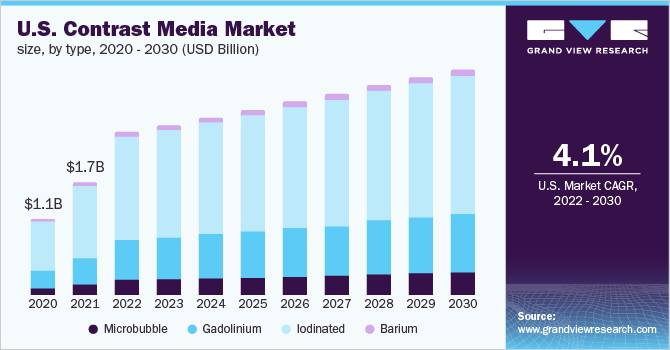
The U.S. contrast media market is anticipated to reach USD3.36 billion by 2030, registering a CAGR of 4.12% over the forecast period, according to a new report by Grand View Research, Inc. The increasing burden of chronic diseases is creating a demand for diagnostic imaging procedures, which, in turn, is driving the market growth. Imaging tests, such as MRI, have become an integral part of the diagnosis for most diseases, and large-scale penetration of imaging technology in healthcare has increased the demand for contrast media in the U.S. market. Chronic diseases, such as cancer and diabetes, are rapidly becoming a major public health concern and are among the leading causes of death across the U.S., resulting in the need for early diagnostic tools and effective treatment options.
U.S. Contrast Media Market Segmentation
Grand View Research has segmented the U.S. contrast media market on the basis of type, modality, and application:
Based on the Type Insights, the market is segmented into Microbubble Contrast Media, Gadolinium-based Contrast Media, Iodinated Contrast Media, Barium-based Contrast Media.
- On the basis of type, iodinated contrast agents captured the largest share of 63.38% of the overall revenue in 2021. This can be attributed to the high penetration of X-ray and CT procedures as well as the availability of nonionic stable iodinated agents for improved diagnosis. Iodine-based contrast media are used to enhance CT and X-ray images. They are used to enhance visualization of the GI tract, internal organs, arteries & veins, soft tissues, and the brain. Generally, all radiological examinations performed using injected contrast media involve iodinated contrast media. Iodine-based contrast media have excellent radio-opacity and low toxicity than other agents.
- Iodinated contrasted media are widely applicable in a broad number of indications including neurological, nephrological, gastrointestinal, cardiovascular, and musculoskeletal disorders as well as cancer. Thereby, contributing to the segment growth.However, gadolinium-based contrast media are anticipated to grow at the fastest CAGR during the forecast period. Its role in increasing image clarity, enhancing the visibility of blood vessels, inflammation, and tumors improves the overall diagnostic accuracy without the risk of exposure to ionizing radiation. Generally, they are used to enhance imaging of internal organs, the GI tract, brain, arteries & veins, and soft tissues. Gadolinium-based contrast media are also indicated for cardiovascular disorders, neurological disorders, and cancers.
Based on the Modality Insights, the market is segmented into Ultrasound, Magnetic Resonance Imaging (MRI), X-ray/Computed Tomography (CT Scan).
- On the basis of modalities, the market has been further segmented into ultrasound, Magnetic Resonance Imaging (MRI), and X-ray/Computed Tomography(CT). X-ray/CT was the largest segment in 2021 and accounted for a revenue share of more than 65.5%. Wide acceptance and cost-efficiency of X-ray/CT modality boost the adoption of contrast agents used for this modality type. X-ray/CT-based contrast agents comprise iodinated agents and barium-based contrast agents that are used in diagnostic procedures for numerous diseases and are less expensive.
- In addition, X-ray/CT contrast agents help produce high-resolution 3D images of structures, thereby, contributing to the segment growth.However, the magnetic resonance imaging segment is expected to grow at the fastest CAGR during the forecast period. Nowadays, gadolinium contrast agents are used in nearly one out of three MRI scans, which indicates the popularity of these agents in MRI procedures. MRI contrast agents are most often the best option for imaging of soft tissues for the detection of cancer. In addition, they are used to visualize lesions during MRI scans for detection of neurological disorders, aortoiliac occlusive diseases, and liver diseases.
Based on the Application Insights, the market is segmented into Cardiovascular, Neurological Disorders, Gastrointestinal Disorders, Cancer, Nephrological Disorders, Musculoskeletal Disorders, Others.
- In 2021, the neurological disorder segment accounted for the highest revenue share of more than 29.00%. Diagnostic evaluation of CNS for neurological disorders boosts the adoption of MRI contrast agents as they provide better images of neural structures than CT. GBCAs are utilized for visualization of demyelinated, inflammatory, and neoplastic lesions.Gadavist, Dotarem, and Prohance are the most widely used macrocyclic GBCAs for the diagnosis of neurological disorders in the U.S. In addition, X-ray/CT contrast agents find wide applications in diagnosing neurological conditions, which further contributes to the segment growth.
- However, the cardiovascular disorder segment is expected to grow at the fastest CAGR during the forecast period. Contrast-enhanced ultrasound imaging of the cardiovascular system or echocardiography is the most widely used modality for imaging of the cardiovascular system in adult and pediatric patients. Optison, Definity, and Lumason are the most widely used ultrasound contrast agents in the U.S. They are indicated in patients with suboptimal echocardiograms for opacifying the left ventricle and improving delineation of the left ventricular endocardial border. Moreover, the removal of contraindications for ultrasound contrast agents and extended use of Visipaque are cumulatively expected to boost MRI and CT contrast material sales, particularly in the U.S.
Market Share Insights
- September 2021: Lantheus Holdings, Inc. and RefleXion Medical, Inc., announced development and commercialization collaboration in evaluating the use of piflufolastat F18, Lantheus’ prostate-specific membrane antigen (PSMA)-targeted positron emission tomography (PET) imaging agent, to enable real-time therapeutic guidance of biology-guided radiotherapy.
Key Companies Profile & Market Share Insights
Key players are adopting strategies, such as mergers & acquisitions and indication extension, to enhance their market position. Acquisitions aid companies in increasing their presence with wider geographical reach and stronger portfolios.
Some of the prominent players operating in the U.S. contrast media market include,
- Bayer AG
- GE Healthcare
- Guerbet
- Lantheus Medical Imaging, Inc.
- Bracco Diagnostic, Inc.
- Nano Therapeutics Pvt. Ltd.
- Trivitron Healthcare
- CMC Contrast AB
- IMAX Diagnostic Imaging
Order a free sample PDF of the U.S. Contrast Media Market Intelligence Study, published by Grand View Research.


Comments
Post a Comment