Cardiac Rhythm Management Devices Market Analysis by Application 2030
Cardiac Rhythm Management Devices Market Growth & Trends
The global cardiac rhythm management devices market size is anticipated to reach USD 31.9 billion by 2030, according to a new report by Grand View Research, Inc. The market is expected to expand at a lucrative CAGR of 6.5% from 2022 to 2030. The key factors driving the market include growth in the adoption of cardiac rhythm management (CRM) devices owing to the increasing prevalence of cardiovascular disorders. According to the Centers for Disease Control and Prevention (CDC), as of September 2021, approximately 659,000 Americans die suffering from heart disease every year. The market was negatively impacted during the COVID-19 pandemic, as elective procedures, including the non-essential cardiovascular procedures, were postponed or canceled during the pandemic.
Cardiac Rhythm Management Devices Market Segmentation
Grand View Research has segmented the global cardiac rhythm management devices market on the basis of product and region:
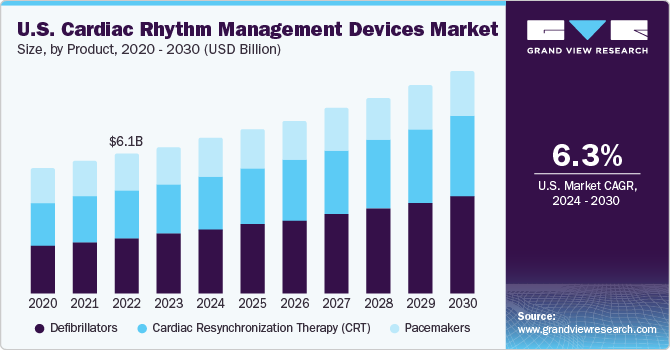
Based on the Product Insights, the market is segmented into Pacemakers, Defibrillators, Cardiac Resynchronization Therapy (CRT).
- The defibrillators segment dominated the CRM devices market and held the largest revenue share of 43.6% in 2021. The dominance is a result of rising adoption, especially of the Subcutaneous Implantable Defibrillator (S-ICD) and Transvenous Implantable Cardioverter Defibrillator (T-ICD), in major regional markets such as the U.S., European countries, China, and India. Defibrillators are further classified into Implantable Cardioverter Defibrillators (ICD) and external defibrillators. The external defibrillatorsegment is anticipated to witness the fastest growth rate of 9.3% over the projected period, owing to the growing adoption of these defibrillators, especially in public places.
- Within the pacemakers’ segment, the implantable segment held the largest revenue share. The implantable pacemakers have become a well-established treatment for sinus node dysfunction and conduction disorders. Increasing application of these for the treatment of arrhythmias and heart failure as well as in ongoing clinical investigations is a major factor leading to segment growth. Furthermore, the cardiac resynchronization therapy (CRT) segment is expected to witness a significant growth rate over the forecast period. Associated benefits such as reduced blood transfusion, risk of infections, and hospital stay are key drivers for this segment. Healthcare practitioners are increasingly recommending minimally invasive surgeries for CRT-Pacemaker implantation to curb bradycardia and cardiac arrest instances. The preference for minimally invasive techniques for CRT-P implantation is expected to boost sales during the forecast period.
Cardiac Rhythm Management Devices Regional Outlook
- North America
- Europe
- Asia Pacific
- Latin America
- Middle East & Africa
Market Share Insights
- July 2020: Abbott received the U.S. Food and Drug Administration (FDA) clearance for its Gallant ICD and CRT-D devices. This enabled the company to market the device in the U.S. while expanding its portfolio.
Key Companies Profile & Market Share Insights
The industry is marked by the presence of various large and small business operators.
Some of the prominent players operating in the global cardiac rhythm management devices market include,
- Physio-Control, Inc. (Stryker)
- Schiller
- Medtronic
- Abbott
- Boston Scientific Corporation
- Koninklijke Philips N.V.
- Zoll Medical Corporation
- BIOTRONIK
- Progetti Srl
- LivaNova Plc
Order a free sample PDF of the Cardiac Rhythm Management Devices Market Intelligence Study, published by Grand View Research.


Comments
Post a Comment