Brachytherapy Treatment Planning Systems Market Share, Current Impact, and Holistic View 2030
Brachytherapy Treatment Planning Systems Market Growth & Trends
The global brachytherapy treatment planning systems market size is expected to reach USD 1.5 billion by 2030, registering a CAGR of 9.3% over the forecast period, according to a new report by Grand View Research, Inc. The global prevalence of cancer and cancer-related mortality is rapidly rising and driving the demand for innovative cancer care solutions. According to Globocan 2020 estimates, in 2020, 19.3 million new cancer cases were detected across the globe. Some of the most commonly diagnosed cancer cases are breast cancer, prostate cancer, lung cancer, and colorectal cancer. According to the WHO, globally, cancer is a leading cause of death claiming one in every six lives.
Brachytherapy Treatment Planning Systems Market Segmentation
Grand View Research, Inc. has segmented the global brachytherapy treatment planning systems market on the basis of component, technique, and region:
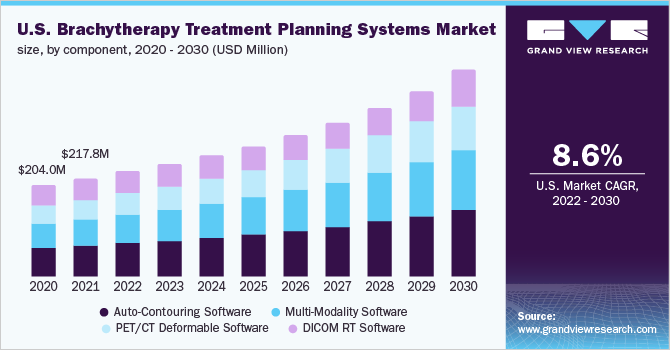
Based on the Component Insights, the market is segmented into Auto-Contouring Software, Multi-Modality Software, PET/CT Deformable Software, DICOM-RT Software.
- The auto-contouring software segment dominated the market in 2021 and accounted for the largest revenue share of 31.1% owing to the growing popularity and adoption of auto-contouring software solutions over manual contouring software. Manual contouring techniques lack standardization, efficiency, and accuracy, restrain their adoption, and support the growth in demand for partial or fully automatics contouring solutions for radiation therapy. Automatic contouring using Hounsfield values is used in reducing turnaround time and enhancing accuracy. According to case studies published by MIM Software, 10 minutes are saved per patient on prostate target volume contouring in radiation oncology.
- PET imaging provides information on the intensity and extent of the tumor while CT imaging outlines the anatomical structure of the tumor and surrounding healthy tissues. Deformable image registration combines the images from two or more modalities into a common coordinate system. For better correlation of the tumor, PET and CT images can be co-registered. Deformable image registration is used for organ delineation, targeting volume definition, and dose calculation. The driving forces of this segment include an increase in the number of acquired image datasets, advancements in multi-modal images in treatment planning, and the adoption of image-guided radiotherapy practices.
Based on the Technique Insights, the market is segmented into 3D Image Reconstruction, In-Room Imaging, Image Registration using Graphics Processor Unit.
- The in-room imaging segment dominated the global market in 2021 and accounted for the largest revenue share of 55.4% owing to constant technological innovations in the radiation therapy space. In-room imaging techniques are gaining popularity due to the enhanced accuracy & precision and growing emphasis on normal tissue radiotherapy toxicity reduction and dosage volume reduction. Therefore, in-room imaging aids in reducing therapy uncertainties. The in-room imaging process provides radiologists with real-time image datasets and allows them to overcome challenges arising from movable tumors and target lesions.
- On the other hand, the 3D image reconstruction segment is anticipated to register the fastest CAGR over the forecast years. 3D image reconstructions function through image segmentation, image registration, and image visualization. 3D image reconstruction processes are used to create 3D image projections through multiple techniques, such as photometric stereo handling, multiple Kinect capturing system, triangulation method, and visualization.
- Various benefits offered by 3D image reconstruction techniques are dosage distribution planning, minimal collateral tissue damage, and optimal treatment process realization. The increasing demand for accurate & precise oncology treatment practices to improve patient outcomes and tackle the rapid prevalence of cancer incidence across the globe is driving the 3D image reconstruction segment. Healthcare infrastructure is rapidly advancing and incorporating innovative technologies, which is another driving factor for this segment. Developments in spatial registration and fusion of 3D images procured from different modalities are shaping the segment growth.
Brachytherapy Treatment Planning Systems Regional Outlook
- North America
- Europe
- Asia Pacific
- Latin America
- Middle East & Africa
Market Share Insights
- August 2020: Elekta entered into an agreement with Healthcare Global Enterprises Ltd. (HCG) for the installation of various linac systems, such as Versa HD, Elekta Unity, and Elekta Synergy in India. This service agreement will help the company in gaining a foothold in the Indian market.
Key Companies Profile & Market Share Insights
These key players are devising innovative product development strategies to expand their product portfolio and gain a competitive edge. Companies are collaborating with each other to leverage their technological capabilities. In addition, companies are strategically investing in various mergers & acquisitions to expand their product portfolios.
Some of the prominent players operating in the global brachytherapy treatment planning systems market include,
- Elekta AB
- RaySearch Laboratories
- Varian Medical Systems
- Prowess Inc.
- MIM Software Inc.
Order a free sample PDF of the Brachytherapy Treatment Planning Systems Market Intelligence Study, published by Grand View Research.


Comments
Post a Comment