Roofing Materials Market Competitive Landscape Report to 2030
Roofing Materials Market Growth & Trends
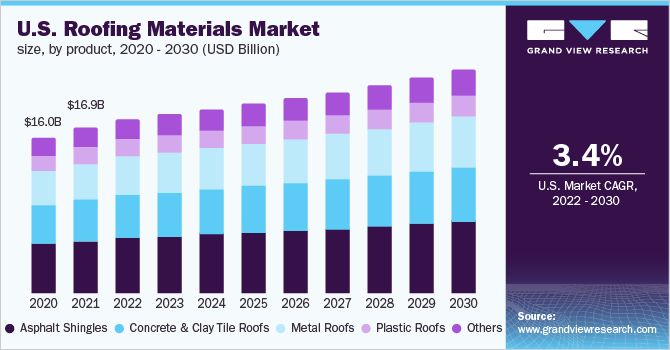
The global roofing materials market is expected to reach USD 171.25 billion by 2030, registering a CAGR of 4.0% from 2022 to 2030, as per a new report by Grand View Research Inc. Increasing investments in the renovation and redevelopment of residential and non-residential buildings are expected to drive the market growth.
Roofing Materials Market Segmentation
Grand View Research has segmented the global roofing materials market on the basis of product, application, and region:
Based on the Product Insights, the market is segmented into Asphalt Shingles, Concrete & Clay Tile Roofs, Metal Roofs, Plastic Roofs, Others.
- Concrete and clay tiles product segment led the market and accounted for more than 29% share of the global revenue in 2021. These tiles offer benefits such as improved aesthetics, durability, and ease of recycling, hence drive the product demand. However, growing consumer preference for stone-coated steel roofing is projected to impede product demand.
- Asphalt shingles segment is projected to register a CAGR of 4.1% in terms of value over the forecast period. Low capital costs and an easy installation process are anticipated to drive the demand for asphalt shingles as roofing materials over the forecast period.
- In 2021, the metal roof segment held a share of 22.4% of the overall market in terms of revenue. Metal roofs are versatile and can be converted into any desired shape such as shingles or slates to fit the surface structures of different types of buildings. Moreover, the low lifecycle costs, less weight, and fire resistance of metal roofs are expected to drive their global demand over the forecast period.
- The plastic roof segment is anticipated to grow at a CAGR of 2.6% over the forecast period owing to advantages such as ease of installation, and low maintenance. However, plastic roofs offer lower aesthetic appeal than their counterparts. Furthermore, the product is particularly vulnerable to UV radiation degradation, thereby restricting its application.
Based on the Application Insights, the market is segmented into Residential and Non-residential.
- Residential application segment led the market and accounted for more than 55% of the global revenue share in 2021.Factors such as the increasing global population and rising preference of consumers for single-family housing structures are anticipated to fuel the growth of residential segment of roofing materials market during the forecast period.
- Evolving business models, new startups, and increased need for office spaces are expected to drive the global demand for non-residential buildings. Furthermore, rising expenditures in the construction of data centers by major technological companies like as Microsoft, Google, and Amazon are expected to boost demand for roofing materials used in non-residential structures. Rising investments for the renovation and replacement of roofs of commercial buildings, such as hospitals, educational institutions, sports facilities, government offices, and recreational buildings are anticipated to fuel the penetration of roofing materials in various non-residential applications.
Roofing Materials Regional Outlook
- North America
- Europe
- Asia Pacific
- Central & South America
- Middle East & Africa
Key Companies Profile & Market Share Insights
The global market is characterized by the presence of various small- and large-scale vendors, resulting in a moderate level of concentration in the market.
Some of the prominent players operating in the global roofing materials market include,
- GAF Materials Corporation
- Atlas Roofing Corporation
- Owens Corning
- TAMKO Building Products, Inc.
- CSR Ltd.
- Carlisle Companies Inc.
- Crown Building Products LLC
- Metal Sales Manufacturing Corporation
- Wienerberger AG
- Etex
- CertainTeed Corporation
- Johns Manville
- Fletcher Building Limited
- Eagle Roofing Products
- Boral Roofing
Order a free sample PDF of the Roofing Materials Market Intelligence Study, published by Grand View Research.


Comments
Post a Comment