Transcutaneous Electrical Nerve Stimulation Market Company Revenue Shares And Analysis 2030
Transcutaneous Electrical Nerve Stimulation Industry Overview
The global transcutaneous electrical nerve stimulation market size was valued at USD 300 million in 2021 and is projected to grow at a compound annual growth rate (CAGR) of 3.84% from 2022 to 2030.
The demand for transcutaneous electrical nerve stimulation devices is increasing owing to the rising cases of chronic pain and musculoskeletal injuries, especially among older citizens. Transcutaneous Electrical Nerve Stimulation (TENS) devices are primarily used to treat sports injuries, muscle atrophy, nerve pain, arthritis, labor pain, and back & neck pain. In addition, muscle injuries are becoming common among younger adults owing to increased involvement in sports and other physical activities. Therefore, a large number of sports enthusiasts are these days espousing muscle stimulation 2therapies such as TENS therapy to assist in warm-ups and rehabilitation in case of an injury. Also, sports participation has increased in 2020-21, as the COVID-19 pandemic has led to people having more free time.
Gather more insights about the market drivers, restrains and growth of the Global Transcutaneous Electrical Nerve Stimulation Market
Moreover, ongoing technological advances and product innovations such as wearable TENS will provide significant growth opportunities to the market players over the forecast period. All these aforementioned factors will augment the overall transcutaneous electrical nerve stimulation market growth shortly.
The COVID-19 outbreak has affected millions of people around the world. The pandemic has compelled the healthcare industry to take action, in a race to develop both therapeutic and preventive interventions. This has negatively impacted the healthcare businesses as well as consumer spending. Chronic & acute pain management services were considered non-urgent during the pandemic. Due to this, all outpatient, as well as elective interventional procedures, were reduced or interrupted during the pandemic for reducing the risk.
Specialty centers for pain management were also shut down during the pandemic, which further negatively impacted the market. Moreover, the pandemic led to the adoption of pain management medications instead of pain management devices, which negatively impacted its market growth.
However, many COVID-19 patients have been facing physiological disabilities affecting respiratory, cardiovascular, and musculoskeletal function due to long-term ICU admission. Palsy of the skeletal system and respiratory muscles has also been observed in some cases. As a result, rehabilitation of such patients is emerging as a major challenge worldwide. Therefore, demand for different muscle stimulation devices including TENS is expected to positively impact the market growth in upcoming years.
In addition, numerous muscle stimulation devices have gained regulatory approval during this phase. For instance, in April 2020, Synapse Biomedical has received had received the U.S. FDA Emergency Use Authorization (EUA) for its TransAeris- a diaphragm stimulator that assists Covid-19 patients to get off mechanical ventilation. Thus, a large number of COVID-19 patients recovering worldwide is expected to spur the demand for TENS in homecare settings. This will certainly fuel the market growth during the forecast period.
Moreover, many studies such as NCBI, and IJAM have suggested that TENS is effective in the treatment of muscle weakness and able to restore muscle strength in admitted patients, especially in ICU. Therefore, many companies such as NeuroMetrix, Inc., and others have started clinical trials of TENS for Post-Acute COVID-19 Syndrome (PACS). Thereby, supporting the market growth during the study period.
Furthermore, the ineffectiveness of oral drugs is prompting patients to look for alternative treatment options, such as electrotherapy devices. Several people are addicted to pain killers; however, these medicines can not only lead to adverse effects but may also be ineffective. According to a study published in Practical Pain Management, 14.0% of patients that were administered codeine experienced less discomfort.
In addition, scientists revealed that there was no single drug that provided pain relief to patients. Also, low preference for surgeries is one of the factors boosting the demand for TENS devices. Several patients tend to avoid surgery if alternative treatments are available. Thus, supporting the market growth during the forecast period.
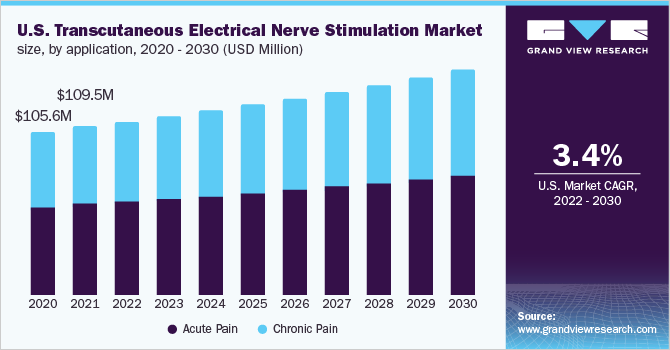
The U.S. dominated the overall market with market revenue shares of 83.10% in 2021. The growing adoption of a sedentary lifestyle is leading to a rise in the prevalence of chronic pain disorders, such as osteoarthritis, back pain, and fibromyalgia are contributing to the growth of the market in the country. For instance, according to the National Fibromyalgia Association, as of August 2019, fibromyalgia affected 10 million people in the U.S. This has fueled the demand for TENS devices to help manage chronic pain.
In addition, according to CDC, as of July 2019, osteoarthritis affects 32.5 million adults in the U.S. Moreover, insurance coverages available for TENS devices by Medicare along with the presence of key players in the market are further expected to drive the market growth in the U.S.
Furthermore, technological advancements in electrotherapy devices are anticipated to drive the market. Electrotherapeutics are evolving and incorporating new functions, including neuromodulation or communication, with the central nervous system. Scientists, researchers, & healthcare providers have begun to tap into advanced circuitry and electrical signaling to modulate nerve function.
Recent technological advancements in this field include products such as automatic, wearable, transcutaneous, and electrode-based electrical nerve stimulators. These devices provide pain relief within minutes. In January 2018, Omron Healthcare introduced an over-the-counter electrotherapy device for safe and effective drug-free pain relief named- Avail. It is a TENS unit with wireless and dual-channel capability that provides relief from chronic and acute pain. Such advancements are expected to foster market growth in the region during the forecast period.
Browse through Grand View Research's Medical Devices Industry Research Reports.
- Vessel Sealing Devices Market - The global vessel sealing devices market size was estimated at USD 1,510.0 million in 2022 and is expected to expand at a compound annual growth rate (CAGR) of 9.04% from 2023 to 2030.
- Foley Catheter Market - The global foley catheter market size was valued at USD 1.64 billion in 2022 and is expected to expand at a compound annual growth rate (CAGR) of 5.81% from 2023 to 2030.
Market Share Insights
- September 2020: A leading provider of neurostimulation-based medical devices- NeuroMetrix Inc., has launched the Quell App for Apple Watch users. It is a wearable, TENS device for knee, foot, and leg pain that is available over the counter (OTC).
- April 2021: DJO (Colfax Corporation) completed the acquisition of MedShape, Inc a leading provider of medical devices for fracture fixation, joint fusion, and soft tissue injury repair.
Key Companies profiled:
Some prominent players in the global transcutaneous electrical nerve stimulation market include
- OMRON Corporation
- Zynex Medical
- NeuroMetrix, Inc.
- EMS Physio Ltd.
- BioMedical Life Systems
- DJO Global, Inc.
- Globus
Order a free sample PDF of the Transcutaneous Electrical Nerve Stimulation Market Intelligence Study, published by Grand View Research.


Comments
Post a Comment